









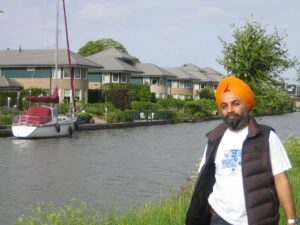

Harinder Singh – 1469 Original
Cannaugh Place
New Delhi
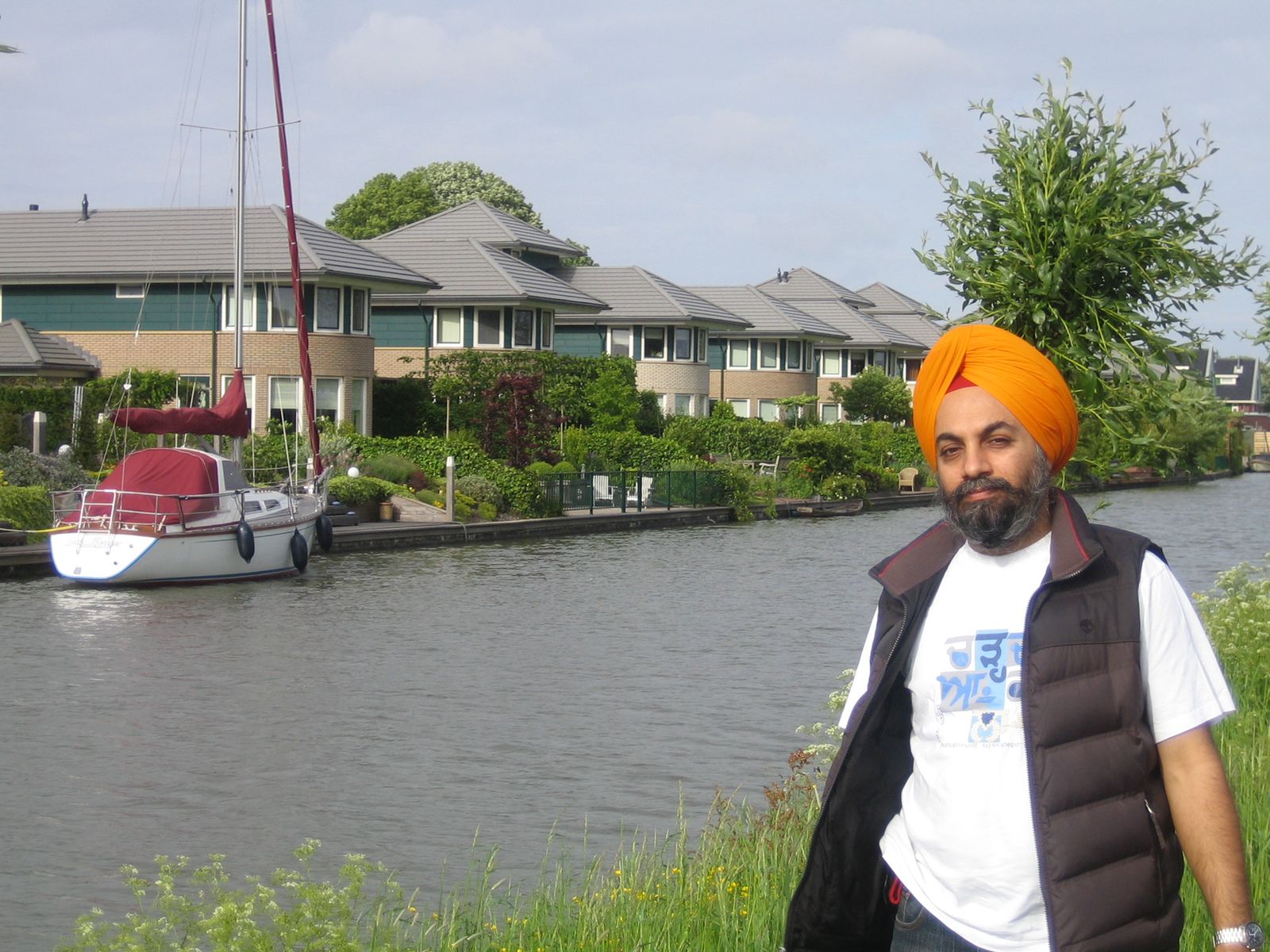
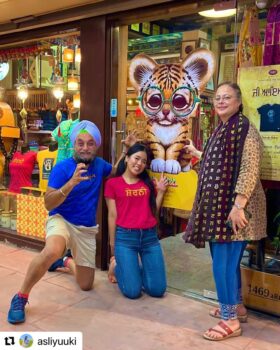
Harinder Singh was born and raised in Delhi. He was born to Iqbal Singh and Gurjeet Kaur in April 1967 in Delhi, Harinder Singh was brought up in a gursikh family that inculated values of honesty, humility, hard work and sharing. Both paternal and maternal grandparents imparted knowledge about Sikh history. He studied in Guru Harkrishan Public School India Gate and then graduated with a B com from Guru Gobind Singh School College of Commerce. He was not very bright in studies but his creative mind lit up with ‘out of the box’ ideas. He was always enterprising and encouraged taking risks. Thats how he entered the textile industry from the family owned steel business, to make a good looking tee short for the indian market. The first few years had struggle and disappointments too, but his will and perseverance paved the way to success. After successfully giving a quality clothing brand, Unistyle to India he went ahead to make high fashion garments for reputed brands worldover. In 1995, he got married to a Sikh girl from Chandigarh who shared his passion for Panjab and Punjabi. They were blessed with a son in Dec 1995, Manmeet Singh. It was surprising for them when sikhs and panjabis of Delhi quite surprised to see them converse with their toddler in Punjabi. They realised that somewhere people are losing the love and pride of their mother tongue. They decided to launch a brand which would make panjabi fashionable. Thus was born 1469 to connect us to our roots.
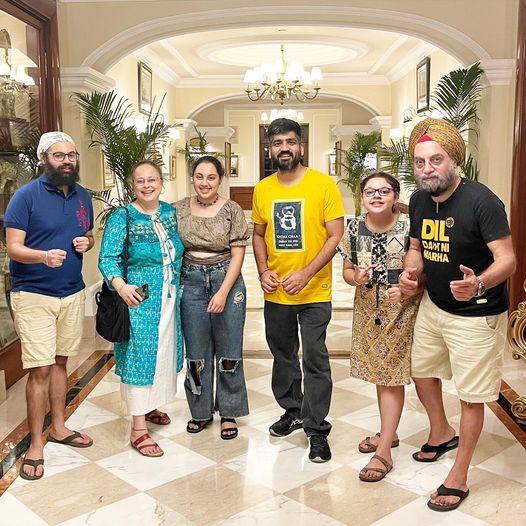
Harinder Singh and Kirandeep Kaur were blessed with two daughters, Pranvat Kaur in 2003 and Gurnadar Kaur in 2011. All his 3 kids speak fluent panjabi inspite of studying in a pricate school in Delhi. They believe in the ideology of their parents and participate as much as they can.
His life is ruled by these 3 principles given to Sikhs by their first Guru. A commerce graduate from DELHI University, Harinder Singh is a likeable personality with a charming sense of humour. He has just completed half century and looks forward to spending quality time of his life with art and family.
His affair with Panjab goes back to his childhood.Partition of the greater Panjab in 1947 brought his family of landlords from Okara ( now in Pakistan) to Amir Khas(Ferozepur). His grandfather struggled to make a life for himself & his family.In 1952 he migrated to Delhi & since they have become the modern delhites. Inspite of having been born n brought up in the capital his heart still belongs to the green fields,rustic farmer & uncomplicated rural life of the ‘land of five rivers’.Though his mind was always fertile with ideas pertaining to Panjab, they took presentable form in 2005 with the launching of the brand called 1469( after the birth of Guru Nanak Dev ji) as it marked the beginning of a new phase in his personal & professional life.He adapted his knack of making a good tee shirt which he had been making for domestic & export market since 1989, to create a virgin & unique concept of Panjabi slogan tees.To complete the experience of Punjab he took the bold step of collecting the maximum number of phulkaris under one roof by sourcing them from various sectors of Punjab. Acceptance and encouragement took him further to make pottery, paintings, accessories, juttis & what not with the theme – Panjab.
When he used to work for foreign buyers and manufacture high fashion garments for the overseas market, his emphasis was to give creative ideas rather than mere fabrication of the proto. His eye for detail was uncanny.
His work with Punjab and its art and craft got him an opportunity to curate a unique show along with Dr Alka Pande in the visual arts gallery of the India Habitat Centre. This was when the appetite of the artist bin him got satiated. He has successfully put up ‘Mela Phulkari’ ,an ongoing journey through the rich cultural diversity of Panjab, for 6 years in a row.
The creative genius of Harinder Singh not only benefits his brand where he comes up with ideas and merchandise to attract his customers but also gives a sustainable form to his artistic instincts. He paints and sketches a lot. He has created articles of home decor using junk. He is an environmentalist so strongly believes in recycling.
Though the word ‘Phulkari’ is known to the real Punjabi, it was not a known handicraft of Punjab in various parts of India and the world over a decade ago when we started our journey with this craft. As Punjabis worldwide are least know for crafts rather for bhangra and butter chicken. With the inception of 1469, which is a Panjabi conceptual store, Phulkari became a very important part of our merchandise. We realized that the present day Phulkari was confined to be in the form of dupattas and accessories churned out on very limited variety and sometimes inferior fabric. The Phulkari from “Patiala” as most people in Delhi would know was an occasional pick in a ladies wardrobe just for variety rather than a prized possession. This is the Phulkari available in the market about 2 to 3 decades ago.
Since 2005, when our tryst with Panjab and its products started we dug into the history and found that the real Phulkari was actually made a century ago that was embroidered as the dream of a woman for personal use. Phulkari was not made to be sold. All women embroidered them on khaddar from the wrong side of the fabric using silken threads called pat da dhaga. As this was an all-over embroidery leaving no fabric visible, this Phulkari was called the baagh.Various patterns were made and were used as gifts to family members on occasions like wedding, child birth and religious occasions. As we started collecting these old pieces of baaghs we realized that the real Phulkari embroidery was no longer being done. What we could source from the markets of Patiala were cotton phulkaris with regular patterns traced and embroidered in a hurry.
That was the start of our journey with Phulkari. Over the last 14 years we have tried to elevate the quality of Phulkari being made in Panjab.We have added various fabrics to make the craft more wearable. We have introduced stoles of Phulkari which can be worn traditionally as well as with Indo western clothes. At the same time we are empowering the women of Panjab by sourcing these phulkaris from women who embroider these in their homes after their day to day activities rather than made by unskilled labour in other parts of India in a factory environment.
Our endeavours may be a drop in the ocean but somewhere they have been instrumental in making Phulkari recognized as the craft of Panjab to foreigners or even Indians from parts other than North India, by improving its quality and presentation.
In the year 2011, a brand new brand relationship emerged, as Bollywood director Imtiaz Ali took notice of the quirky boutiques that dotted significant locations in Delhi. “During the promotion of their film Rockstar, both Imtiaz Ali and Ranbir Kapoor visited our Chandigarh store and advocated our brand amidst fans with immense grace,” says Harinder.
Phulkari is an expression of a woman’s being. If you see the old patterns of baaghs you will realise before partition and the green revolution how close Phulkari was to each and every woman of Panjab. Where the ‘kaudi bagh’ symbolized fertility and prosperity, the ‘chope’ wrapped in its motifs the blessings of a grandnmother for her grand daughter. The darshan dwaar, the sainchi, the vari da bagh, surajmukhi all baagh patterns had a story to tell. The old pieces made for the family had the love and sweat crafted in to them. The contemporary Phulkari that is made for commercial purpose is not that intricate. Repetitive and simpler patterns are used as the time and labour has to have a sustainable price to it. But even though the Panjabi women, whether living in Panjab or outside, haven’t learnt the art of making Phulkari themselves they still consider it to be a symbolic representation of the love and blessing of a mother to her daughter when she starts a new life after her marriage. The symbolism still remains even though the baaghs aren’t made by the family. On marriages you will still find Panjabis using Phulkari for gifting to friends & family besides the bride. In today’s opulent times especially around big fat weddings, which we personally dissociate with, one of the many functions are theme based and Phulkari is one of them.
Where we are happy that due to use in Bollywood and by premier designers of the country, Phulkari has gained popularity which was long due to it, we are also saddened that at many places machine embroidered patterns are being used and are being portrayed as the real Phulkari. These are the cheaper versions as hand embroidery is expensive as the labour and skill of the craftswomen goes into creating it.
Around 6 years ago when we first shared our collection of baaghs with Dr Alka Pande, the art historian and curator, we realized how Panjab and Phulkari was so close to her heart. Under her aegis and guidance we decided to put up an exhibition of this collection of baaghs in the India Habitat Centre in April 2014 showcasing the richness of the craft of Panjab. In celebration of its vibrance and vividity we called it Mela Phulkari.It was very well taken by the audience of Delhi that tasted a new flavor of Panjab.The year after that in 2015 we dealt with the five facets of culture, language, music, history and heritage of Panjab through Phulkari. 2016 saw Mela Phulkari III comprising of installations of various arists in which they presented their definition of Phulkari. Mela IV in 2017 celebrated Phulkari through the script of Gurmukhi. This year in Feb, we had Mela Phulkari 5 which presented Phulkari through the etiology of five. In this journey of Mela Phulkari we have been able to not only sensitise the audience to the story of Phulkari but in the process mobilise the rural women of Panjab towards progress and self reliance.
https://www.youtube.com/watch?v=SbDnprvRqDU


















Leave a Comment